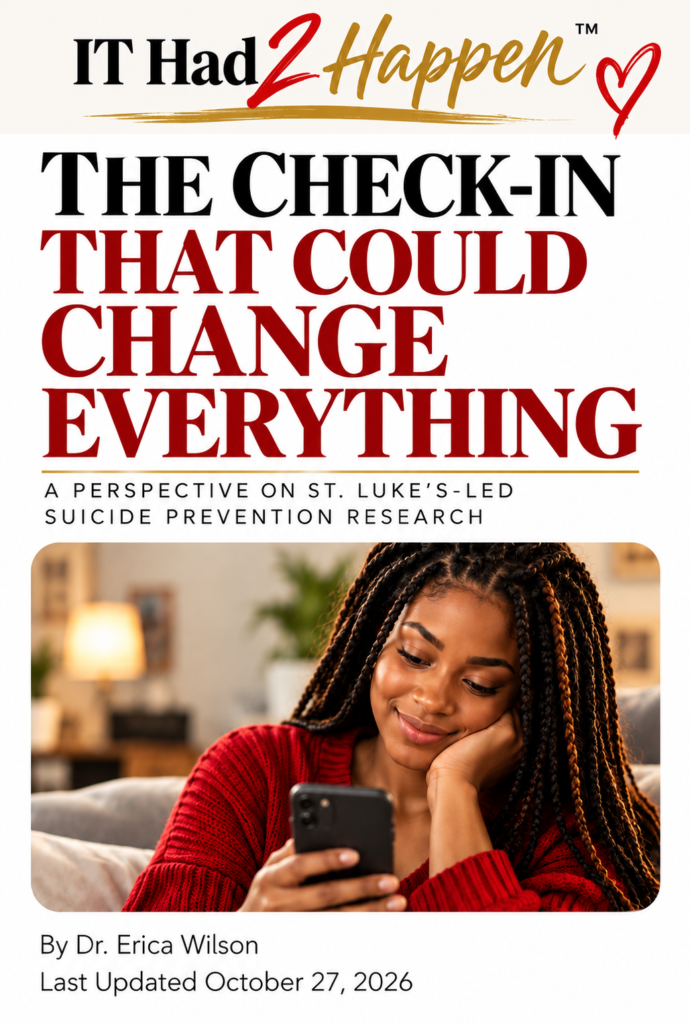

What new suicide-prevention research reveals about connection, follow-up, and the importance of showing up.
By Dr. Erica Wilson
October 28, 2026
⸻
We Tell People to Stay Strong. But Are We Staying Connected?
We live in a world where people are constantly encouraged to be strong, keep pushing, pray harder, and never give up.
But what happens after those words are spoken?
What happens when the phone stops ringing, the visitors leave, and someone is left alone with thoughts they haven’t shared?
We have become good at telling people to stay strong. But how good are we at staying connected?
A newly published suicide-prevention study offers an important opportunity to examine that question.
What the Research Revealed
Research led by St. Luke’s Health System and published in the American Journal of Psychiatry examined two approaches to follow-up support for people identified as being at risk for suicide.
The study, known as the Suicide Prevention Among Recipients of Care (SPARC) Trial, included 1,520 adolescents and adults.
Researchers compared two approaches:
Caring Contacts: Supportive, two-way text messages designed to remind individuals that someone cares and that support remains available.
Instrumental Support Calls: Structured telephone conversations that help individuals address barriers, review safety plans, connect with resources, and access mental health treatment.
The findings suggested that different age groups may benefit from different forms of follow-up.
Among adolescents, Caring Contacts were associated with better suicide-risk outcomes at 12 months, including fewer self-reported suicide attempts during the latter half of the study.
Among adults, practical support calls were associated with lower suicide risk and loneliness during the first six months.
These findings highlight the importance of tailoring follow-up support to individual needs rather than assuming that one approach works equally well for everyone.
The IH2H Perspective: Connection Must Go Beyond Conversation
Here’s what stood out to me.
Sometimes we assume that because someone smiled today, they’re doing better.
Because they attended church, went to work, answered a message, or posted something encouraging on social media, we believe everything must be okay.
But appearances don’t always reveal what someone is experiencing internally.
And this is where we must become more intentional.
A check-in should not simply be about receiving a response. It should be about making room for an honest one.
When we ask someone how they’re doing, are we prepared to listen if the answer isn’t what we expected?
Are we willing to follow up tomorrow?
Next week?
After the immediate crisis has passed?
Because genuine care should not have an expiration date.
The Difference Between Saying You Care and Showing You Care
This research reminds us that meaningful support can take different forms.
For one person, a thoughtful message may help them feel remembered.
For another, support may mean helping them find a counselor, make an appointment, locate resources, or overcome a practical obstacle.
Neither approach should be mistaken for a guaranteed solution or a replacement for appropriate professional care.
But both invite us to consider something important:
Sometimes people need more than encouragement. They need connection accompanied by action.
As a trauma recovery coach, I believe we must create environments where people can acknowledge their struggles without being judged, dismissed, or pressured to pretend they’re okay.
We cannot expect people to speak openly about their pain if we haven’t made it safe for them to be heard.
Don’t Just Celebrate Their Survival
One of the messages I want readers to take away is this:
DON’T JUST CELEBRATE PEOPLE FOR SURVIVING. CARE ABOUT HOW THEY’RE LIVING.
Check on the person who always checks on everybody else.
Reach out to the friend who has grown unusually quiet.
Remember that even strong people need support.
And when someone shares that they are struggling, take them seriously. Listen without judgment and help them connect with qualified support when needed.
We may not always know what another person is carrying.
But we can become more intentional about how we show up.
Beyond the Headline: The Conversation We Need to Have
The St. Luke’s research contributes to a larger conversation about how healthcare systems can support people after suicide risk has been identified.
My perspective is about what that conversation can teach us as individuals, families, and communities.
Not every message will change someone’s circumstances.
Not every conversation will resolve someone’s pain.
But consistent, compassionate connection deserves our attention.
Because sometimes the most important part of checking in is what happens after someone answers.
A Question for Our Community
When was the last time you checked on someone without needing anything from them—and made space for an honest answer?
Let’s create conversations that encourage connection, compassion, and meaningful support.
The Story. The Facts. The IH2H Perspective.
IT Had 2 Happen™️
Real. Raw. Redeemed.
Research Attribution
This article is an independent editorial perspective based on research led by St. Luke’s Health System.
Original reporting: St. Luke’s Health System, “St. Luke’s-led suicide prevention study published in leading psychiatry journal,” by Joy Prudek, October 27, 2026.
Research: Suicide Prevention Among Recipients of Care (SPARC) Trial, published in the American Journal of Psychiatry.
https://doi.org/10.1176/appi.ajp.20260157
IH2H Educational Disclaimer
This is an independent IH2H commentary on published research, not an IH2H research study or clinical suicide-prevention program. This content is educational and does not replace professional mental health assessment or treatment.
If you or someone you know needs immediate emotional crisis support in the United States, call or text 988.