WHY THIS ARTICLE? WHY NOW?
On October 26, 2026, the American Friends of the Hebrew University shared findings from a newly published study examining why some people recover from traumatic experiences while others continue to struggle with psychological distress.
The study, published in Clinical Psychological Science on October 12, 2026, followed 1,035 Israeli adults during the six months following the October 7, 2023, attacks and the ensuing war.
Researchers identified four different patterns of psychological distress. Some participants experienced relatively low levels of distress that declined over time. Others experienced initial distress followed by improvement. Some continued to struggle, while a smaller group experienced increasing distress later.
The findings revealed something important: people do not all respond to trauma in the same way, and recovery does not follow one universal timeline.
These results describe the participants in this particular study and should not be interpreted as a prediction of how every individual will respond to trauma.
But the research raises a question that extends far beyond the study itself.
If people experience trauma differently, why do we keep expecting everyone to heal the same way?
That’s the question that prompted this article.
At IT Had 2 Happen™️, we believe research should do more than inform us. It should challenge how we think, how we respond, and how we treat one another.
And this research challenges a deeply rooted expectation in our families, communities, workplaces, and even places of worship.
The expectation that people should eventually just get over it.
It’s time to go BEYOND THE HEADLINE.
JUST BECAUSE I’M FUNCTIONING DOESN’T MEAN I’M FINISHED HEALING
There is a kind of pain that doesn’t announce itself.
It gets dressed in the morning.
It goes to work.
It takes care of children.
It attends church.
It answers phone calls.
It smiles for pictures.
And sometimes, it even encourages other people.
But behind that smile may be someone still trying to make sense of what happened to them.
We live in a society that often celebrates people for surviving adversity but becomes uncomfortable when their healing takes longer than expected.
We applaud their strength.
We admire their resilience.
We tell them how proud we are that they made it through.
Then, somewhere along the way, the questions begin.
“Aren’t you over that yet?”
“Why are you still talking about what happened?”
“When are you going to move on?”
But what if the person has moved forward in life without fully processing the emotional impact of what they survived?
What if their ability to function has been mistaken for their ability to heal?
That’s the conversation we need to have.
WHAT THE RESEARCH ACTUALLY FOUND
Researchers Dana Katsoty, Anthony D. Mancini, and Ariel Knafo-Noam examined patterns of psychological distress following exposure to mass violence and ongoing threat.
Their study identified four distinct patterns among participants:
54.5% — Relatively resilient: Participants generally experienced lower levels of distress that decreased over time.
29.1% — Recovery: Participants initially experienced elevated distress that subsequently declined.
13.9% — Persistent distress: Participants experienced ongoing psychological distress.
2.5% — Delayed distress: Participants experienced an increase in distress over time.
These findings are important because they demonstrate that emotional responses to trauma are not identical.
However, the study was conducted during an extraordinary period of violence and continuing uncertainty. Its findings should be understood within that context.
The study also followed participants for six months, meaning it does not establish how long recovery ultimately takes.
What it does provide is evidence that people can experience very different patterns of psychological adjustment following traumatic events.
And that should make us more cautious about judging someone else’s recovery.
WHEN SURVIVAL BECOMES A DISGUISE
Some people have become exceptionally good at surviving.
They know how to work through exhaustion.
They know how to remain calm when they’re overwhelmed.
They know how to carry responsibilities even when they feel emotionally depleted.
And they know how to say, “I’m fine,” when the truth is much more complicated.
But survival skills and emotional recovery are not always the same thing.
A person may be able to manage daily responsibilities while still experiencing grief, fear, emotional numbness, intrusive memories, or difficulty trusting others.
These experiences do not automatically mean someone has a mental health disorder. However, persistent or disruptive symptoms deserve attention and, when appropriate, professional assessment.
The U.S. Department of Veterans Affairs explains that trauma-related symptoms can sometimes emerge later or fluctuate over time.
That means an individual who initially appears to be coping well may need additional support months or even years afterward.
The absence of visible pain is not proof of emotional peace.
And sometimes the people who appear strongest are the very people who have learned to hide their struggles most effectively.
THE PRESSURE TO BE THE STRONG ONE
There is another side of healing we don’t discuss enough.
What happens when everyone depends on the person who is hurting?
The mother who never gets to fall apart because her children need her.
The father who carries emotional pain but believes he must never appear vulnerable.
The caregiver who is exhausted from supporting everybody else.
The ministry leader who prays for everyone but struggles to ask for prayer.
The friend who is always available but rarely admits when they need help.
Sometimes strength becomes an expectation rather than a choice.
And when someone is constantly praised for being strong, they may begin to believe that admitting pain means disappointing everyone.
But being strong should never require someone to remain silent about their suffering.
You can be dependable and still need support.
You can have faith and still experience emotional distress.
You can be resilient and still need professional help.
These truths do not contradict one another.
We need to stop creating environments where people feel they must perform strength to remain accepted.
HEALING IS NOT FORGETTING
One of the most damaging expectations placed on survivors is that genuine healing requires forgetting what happened.
But healing does not necessarily erase memories, eliminate every painful emotion, or restore life to exactly what it was before.
According to the U.S. Department of Veterans Affairs, trauma recovery is an ongoing process.
Improvement may involve symptoms becoming less intense, developing healthier ways to manage emotions, and gaining confidence in one’s ability to cope.
For some people, recovery includes reconnecting with relationships, returning to meaningful activities, or finding a renewed sense of safety.
For others, it involves learning to recognize triggers, establish boundaries, and seek support.
And for some, specialized mental health treatment plays an essential role.
Healing is not about pretending the experience never happened. It’s about finding ways to live without allowing its effects to control every part of your present.
Progress may be gradual.
It may include difficult days.
And it may look different from what other people expect.
That does not make the progress meaningless.
ARE WE HELPING PEOPLE HEAL OR PRESSURING THEM TO APPEAR HEALED?
This is where the conversation becomes uncomfortable.
Because sometimes the pressure to move on doesn’t come from strangers.
It comes from the people closest to us.
Family members who are tired of hearing about the experience.
Friends who don’t know what to say anymore.
Partners who become frustrated when old wounds affect current relationships.
Communities that prefer inspirational survival stories over difficult conversations about continuing pain.
And sometimes, religious environments where emotional suffering is treated as evidence of insufficient faith.
We must ask ourselves:
Have we become so impatient with other people’s pain that we’ve started calling their healing process a lack of progress?
When someone says they’re still hurting, our first response should not be to question why.
It should be to listen.
Because the goal is not to make someone appear healed for our comfort.
The goal is to support their well-being.
WHAT SUPPORT ACTUALLY LOOKS LIKE
Supporting someone through trauma recovery does not mean we have to understand every detail of their experience.
It means we can choose to respond with compassion rather than judgment.
Instead of asking, “Why aren’t you over it?”
Ask, “How have you been feeling lately?”
Instead of saying, “You need to move on.”
Try, “What would support look like for you right now?”
Instead of assuming silence means someone is doing well, create room for honest conversations without demanding that they disclose painful details.
Research on social support and trauma recovery suggests that supportive relationships can play a meaningful role in recovery.
A 2024 longitudinal study involving 151 recently trauma-exposed adults examined associations between perceived social support and post-traumatic stress symptoms over time.
The findings support the importance of studying social relationships alongside trauma recovery, although they do not establish that support alone is sufficient to treat trauma-related conditions.
Professional care may also be necessary.
Compassionate relationships and appropriate mental health treatment can work together.
Sometimes the most meaningful thing we can offer another person is permission to be honest about where they are.
THE IH2H PERSPECTIVE: STOP PUTTING A DEADLINE ON SOMEONE ELSE’S HEALING
At IT Had 2 Happen™️, we believe that stories deserve more than an audience.
They deserve understanding.
They deserve compassion.
And they deserve spaces where people can speak without feeling pressured to present a polished version of their pain.
We must be careful not to celebrate someone for surviving an experience and then criticize them because recovery looks different from what we expected.
The woman who is rebuilding her confidence deserves compassion.
The man who is learning how to express his emotions deserves compassion.
The parent who is trying to break unhealthy family patterns deserves compassion.
And the person who thought they were doing well until an unexpected reminder brought painful emotions back deserves compassion, too.
Healing doesn’t have to look impressive to be meaningful.
Sometimes progress is asking for help.
Sometimes it’s establishing a boundary.
Sometimes it’s recognizing that a familiar coping mechanism is no longer serving you.
Sometimes it’s making an appointment with a therapist.
And sometimes it’s simply having the courage to say:
“I’m not where I want to be emotionally, but I’m willing to take the next step.”
That matters.
And it deserves to be recognized.
Healing doesn’t have a deadline. And compassion shouldn’t have an expiration date.
FAITH, HEALING, AND THE COURAGE TO ASK FOR HELP
Ecclesiastes 3:1 reminds us:
“To every thing there is a season, and a time to every purpose under the heaven.” — KJV
For believers, this scripture can serve as a reminder that life unfolds through different seasons.
But we must be careful not to turn this spiritual reflection into a promise that trauma recovery will happen by a particular date.
Faith can provide hope, encouragement, and strength.
It should not become another source of pressure.
Seeking counseling does not mean someone lacks faith.
Taking medication when clinically appropriate does not mean someone has stopped trusting God.
Admitting emotional pain does not make someone spiritually weak.
You don’t have to prove your faith by hiding your pain.
And you don’t have to pretend to be healed to be worthy of love, compassion, and support.
BEFORE YOU TELL SOMEONE TO MOVE ON…
Consider what they may still be carrying.
Consider what it took for them to survive.
Consider whether they’ve had access to safety, support, and the resources needed to recover.
And most importantly, consider whether you’ve created an environment where they can be honest without being judged.
Because sometimes people aren’t refusing to heal.
They’re trying to heal in environments that keep demanding they pretend they’re already healed.
Let us become more intentional about listening.
More patient with people’s journeys.
And more compassionate toward experiences we may never fully understand.
STOP MEASURING SOMEONE’S HEALING BY HOW QUICKLY THEY LEARNED TO SMILE AGAIN.
THE FINAL WORD
We need to change the way we talk about healing.
Not every person who smiles is at peace.
Not every person who functions has fully recovered.
Not every person who remains silent has moved on.
And not every person who revisits their pain is refusing to let go.
Sometimes they’re still learning how to live with what happened.
Sometimes they’re discovering emotions they never had the opportunity to process.
And sometimes they’re taking the very steps toward recovery that others cannot see.
Don’t just celebrate people for surviving. Care about how they’re living.
Because healing is not a competition.
It is not a performance.
And it is not a race against someone else’s expectations.
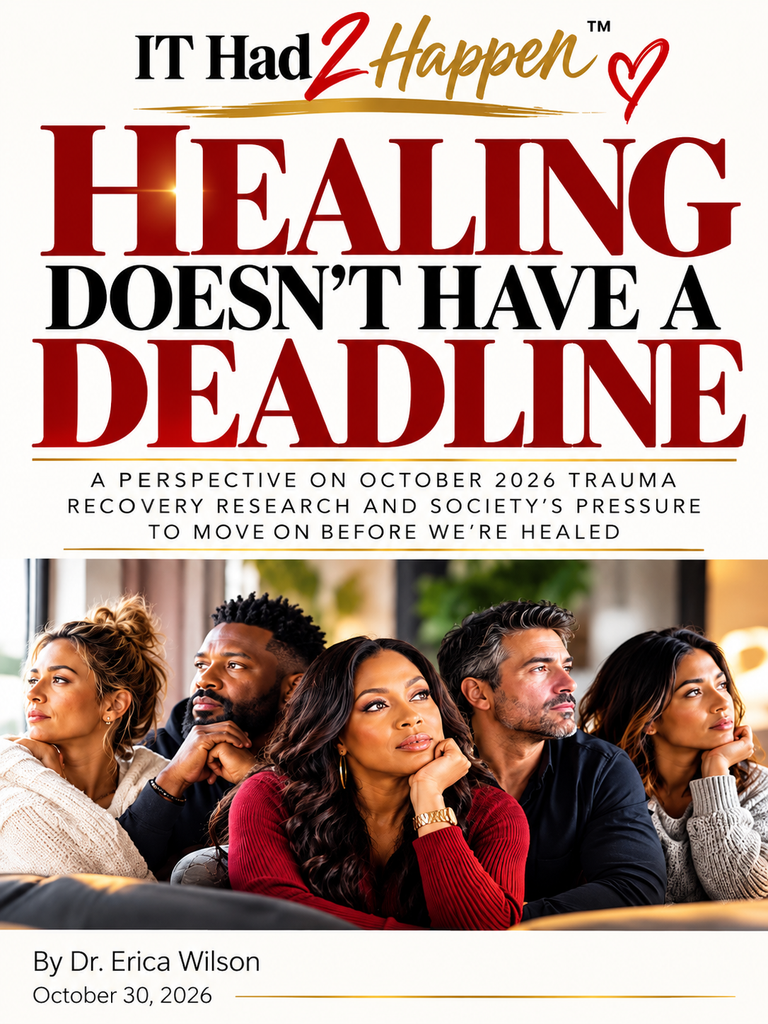
HEALING DOESN’T HAVE A DEADLINE.
And neither should our willingness to show compassion.
LET’S CONTINUE THE CONVERSATION
Have you ever felt pressured to heal before you were ready?
What did you need most during that season?
Was it understanding? Space? Practical help? Professional support? Or simply someone willing to listen without judgment?
We invite you to share your perspective respectfully in the comments.
You never have to disclose painful personal details to participate in this conversation.
At IT Had 2 Happen™️, we believe:
EVERYBODY HAS A STORY. NOT EVERYBODY HAS A SAFE PLACE TO TELL IT.
Let’s continue creating spaces where people can be heard without being rushed, judged, or silenced.
IT Had 2 Happen™️
Real. Raw. Redeemed.
BEYOND THE HEADLINE: The IH2H Perspective
By Dr. Erica Wilson
SOURCES & FURTHER READING
- Research announcement — October 26, 2026
American Friends of the Hebrew University. Why Some People Recover from Trauma While Others Struggle: New Study Tracks Mental Health After October 7.
Read the Original Research Announcement
- Original research — October 12, 2026
Katsoty, D., Mancini, A. D., & Knafo-Noam, A. Psychological-Distress Trajectories and Posttraumatic-Stress-Disorder Symptoms Following Continuous Trauma. Clinical Psychological Science.
Read the Original Scientific Study
- U.S. Department of Veterans Affairs
Understanding PTSD.
- U.S. Department of Veterans Affairs, National Center for PTSD
Self-Care After Disaster Events.
Read the Disaster Self-Care Guide
- Social support and trauma recovery research — 2024
Sippel, L. M., et al. Sources of Social Support and Trauma Recovery. Behavioral Sciences, 14(4), 284.
Read the Social Support Research
DISCLAIMER
This article is intended for educational, informational, and reflective purposes only. It does not provide medical advice, psychological diagnosis, or mental health treatment.
Individual responses to trauma vary. Readers experiencing persistent or disruptive emotional symptoms are encouraged to consult a qualified mental health professional.
The faith-based reflections and IH2H commentary represent the author’s perspective and are separate from the scientific findings cited.
If you or someone you know is experiencing a mental health crisis in the United States, call or text 988 for confidential crisis support. In an immediate emergency, contact emergency services.
© 2026 IT Had 2 Happen™️. All rights reserved.